

Imagine entering a store where product prices are clearly displayed, shelf edges systematically labeled, and promotions stand out with colorful signs. Product barcodes scan successfully at checkout on the first attempt, and inventory is managed by scanning the shelves. Such a store does not happen by chance—it is the result of an effective labeling solution. Retail labeling—price tags, shelf labels, signs, and product labels—directly impacts store efficiency and customer satisfaction. In this article, we explore modern retail labeling: what it includes, how it can be implemented effectively, and what benefits it brings to retail operations.
Getting Price Tags and Shelf Labels Right
Price and product labels are the basic infrastructure of a store. For each product, customers must see the correct price and product information. Traditionally, stores have relied heavily on manual work: price tags are handwritten or stamped onto products using pricing guns. Today, significantly more efficient methods are available. Various label printers and their associated software enable labels to be printed directly from electronic product databases. For example, in a grocery store, an entire department’s price tags—including product name, price, and even a barcode for product information—can be printed at once. The printer produces a uniform batch of labels that staff place in their designated locations. This is fast and reliable—each label contains exactly the same information as in the point-of-sale system, eliminating human transcription errors.
If shelf labeling is neglected, the consequences are unpleasant: customers see one price on the shelf and another at the register, which undermines trust and the shopping experience. Therefore, up-to-date price tags are also important from the store’s perspective. Many stores renew their price tags weekly or whenever prices change. A good practice is to print new labels whenever prices are updated in the system—this can be automated using store management software that compiles changed prices into a list and sends new labels to the print queue. Automation reduces the cognitive load on employees: staff do not need to remember to search for changed prices; the system indicates what needs to be printed and replaced.
What about the printing devices themselves? Retail environments often use compact thermal printers (e.g., direct thermal technology) that print labels from rolls. On the other hand, shelf labels are often so-called non-adhesive edge labels or pocket labels, which are printed on standard A4 printers.
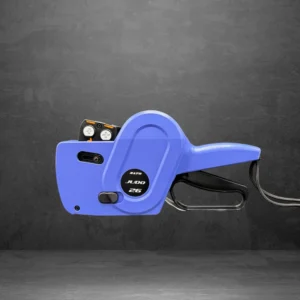
Pricing guns (pricing machines) have not disappeared—they remain convenient for quickly applying discount stickers to batches of products. Consider a situation where fresh products are marked down 30% at the end of the day. Staff can walk between shelves with a pricing gun in hand and rapidly apply red discount stickers to products. These devices are lightweight, easy to use, and compatible with ready-made price labels in various colors and formats. Modern price tag stickers can also include a barcode to identify the discount at checkout. It is important to use high-quality stickers that adhere to products even at refrigerated temperatures.
Contact Premium Pricing Gun
Product number: DISP29x28CMeto Classic M 1626, two-line pricing gun
Product number: 1626 MSato Judo 26, two-line pricing gun
Product number: WAFPA3018Sato Kendo 26, single-line pricing gun
Product number: WACBA3003



In summary: by utilizing printers for shelf and price labeling, stores ensure that prices are correct, labels are clear, and updating is seamless. This also frees up staff time for other customer service tasks.
Barcodes and Product Information – The Foundation for Efficient Operations
Today, virtually every product sold in stores is equipped with a barcode (or sometimes a QR/data matrix code or RFID tag, though barcodes remain mainstream). From the store’s perspective, it is essential that all products are properly equipped with machine-readable identifiers. If you purchase imported products or very small brands, you may occasionally encounter products without a ready-made barcode—in such cases, the store can print a small product label with an internal PLU code or a sticker with its own EAN code. A small printer that prints, for example, 30×32 mm labels from a roll is suitable for this purpose. These stickers ensure that every sale is registered at checkout, and cashiers do not need to enter codes manually (which is slow and error-prone).
The quality of barcode stickers is important: stores should use materials and print settings that achieve sufficient contrast and durability. Codes on shelves and in storage may be exposed to sunlight or moisture in cold storage—barcodes printed using thermal transfer technology remain clear longer than direct thermal labels, which can fade. For example, a price tag on the edge of a freezer bin could be produced using thermal transfer to prevent it from disappearing due to moisture. Similarly, in the garden center section, plant name tags with barcodes must withstand outdoor conditions (UV radiation and watering)—this is achieved by selecting weather-resistant materials and printing methods.
Store inventory and product traceability are simplified through labeling. When shelf locations are marked with identifiers and products have barcodes, portable scanning devices can be used to check stock levels. An employee scans the shelf and product—the system indicates how many should remain, and you can confirm the count. This is far more convenient than manual counting without identifiers. Many modern stores conduct continuous cycle counting using scanning, reducing the need for large inventory days.
Promotions, Signs, and Visual In-Store Marketing
Retail labeling is not limited to small price tags and barcodes—it also includes signs, posters, and other visible materials that stores use to communicate with customers. Promotional periods (such as seasonal sales, Black Friday, etc.) often bring a flood of special signage. Fortunately, these can now be produced flexibly in-store. Large-format printers or A4/A3-sized color printers enable in-store printing of advertising materials: for example, “Buy 3 Pay for 2” signs for shelf ends or instructions for recycling stations. JIT’s product range includes dedicated large-format printers and color printers that can produce high-quality advertising posters or banners.
It is essential to use the right printing materials for these purposes. Indoors, standard cardstock or sticker sheets suffice; outdoors (e.g., an advertising poster on the store’s yard fence), weather-resistant materials and UV-resistant inks are required. JIT offers weather-resistant printing materials such as poster bases and signs that withstand rain and sun. A printer can conveniently produce, for example, changing opening hours printed as a poster for the door or a price sign for the fruit section’s display bins.
Consistent and carefully executed labeling also reflects the store’s brand. Store appearance is strengthened when signs and labels use the same colors, fonts, and style. Customers subconsciously notice that the store has invested in presentation. This creates an impression of organization and professionalism—which can differentiate the store favorably from competitors.
Staff Role and Customer Service
Although digitalization and automation have advanced significantly, the human role in retail labeling remains important. Staff training ensures that printers and systems are used correctly. It is advisable to designate responsible individuals who manage, for example, price updates and the availability of printing supplies (label rolls, ink ribbons). When salespeople understand that proper labeling also makes their work easier (fewer price inquiries, smoother checkout operations, clearer shelf organization), they commit to maintaining them.
Customer service improves when staff do not need to spend time searching for prices or guessing codes. They can trust that the information in the system is visible on the shelf and functions at checkout. This frees up time for genuine customer service: product advice, sales work, and shelf organization. Fast service—thanks to clear labeling—also makes the customer experience pleasant, and well-informed staff can focus on providing added value (rather than apologizing for pricing confusion).
It is also important to remember that unexpected situations may arise in stores where improvised labeling is necessary. For example, if a refrigeration unit breaks down, products must be moved to another location and the situation communicated to customers. In such cases, the ability to quickly print or write a clear sign is invaluable. Even small details, such as a handwritten “Special offer, best before date approaching” label, add a human touch—but this too can be done neatly and in line with the brand if templates and guidelines are provided. Every label a customer sees affects their perception of the store.
New Developments: Digital Price Displays vs. Printed Labels
Finally, it is worth mentioning electronic shelf labels (ESL), which have begun to gain popularity. These are small e-ink displays that update prices wirelessly. Some hypermarkets and specialty stores have thousands of them. They significantly reduce the need for printing price tags—when a price changes, the system automatically updates the number on the display. Does this mean the end of printed labels? Not quite. Electronic displays are expensive as an investment and do not completely eliminate labels: products themselves still often have labels. Additionally, promotional and directional signs, as well as most visual elements, remain printed. Many stores adopt a hybrid model: electronic displays in the most critical locations (e.g., daily changing rates such as fuel prices or fast-moving fresh products), while paper or plastic labels that are replaced traditionally are used elsewhere.
Printing solutions are therefore evolving alongside digital systems. The most important factor is data management in the background: when product and price information is accurate in one place, it can be distributed to different channels—printed on paper or sent to displays.
Summary: Labeling is a Success Factor in Retail
In retail, attention often focuses on product range, customer service, and marketing. Retail labeling may receive less attention because it is seen as routine work. However, as we have established here, efficient labeling processes bring clear improvements to both efficiency and customer experience. A properly priced and labeled store operates like a well-oiled machine: staff save time, customers find information and trust the store, and sales proceed smoothly.
If you feel that your store has room for improvement in labeling—whether it is an old printer that malfunctions or a lack of procedures for updating price tags—now is a good time to renew practices. Explore JIT’s retail solutions for retail operations. Our range includes suitable printers, supplies (e.g., receipt rolls for point-of-sale systems or price tag stickers, etc.), and experts who can train your staff to use new tools efficiently. Small changes to daily routines can have a significant impact: your store becomes more attractive and efficient when labeling is up-to-date and in order. Customers notice the difference—and gladly return to shop where prices are accurate and service runs smoothly.


